“One of the most important principles of investing is to let your rules—not the headlines—make your decisions for you.” – Jason Zweig
The 2026 midterm elections have shifted political power in Washington. Democrats have won control of both the House and Senate, flipping the Republican majorities in Congress. This creates a divided government for the final two years of President Trump’s term, a situation that has occurred many times before under presidents from both parties.
Many news outlets are framing the results as a reaction to the state of the economy, including tariffs and high oil prices tied to the conflict with Iran. While specific policies can affect certain industries, longer-term trends around AI, inflation, and economic growth tend to matter more for financial markets overall. For investors, it is worth putting politics aside and focusing on long-term financial goals.
Consumer sentiment remains near historic lows
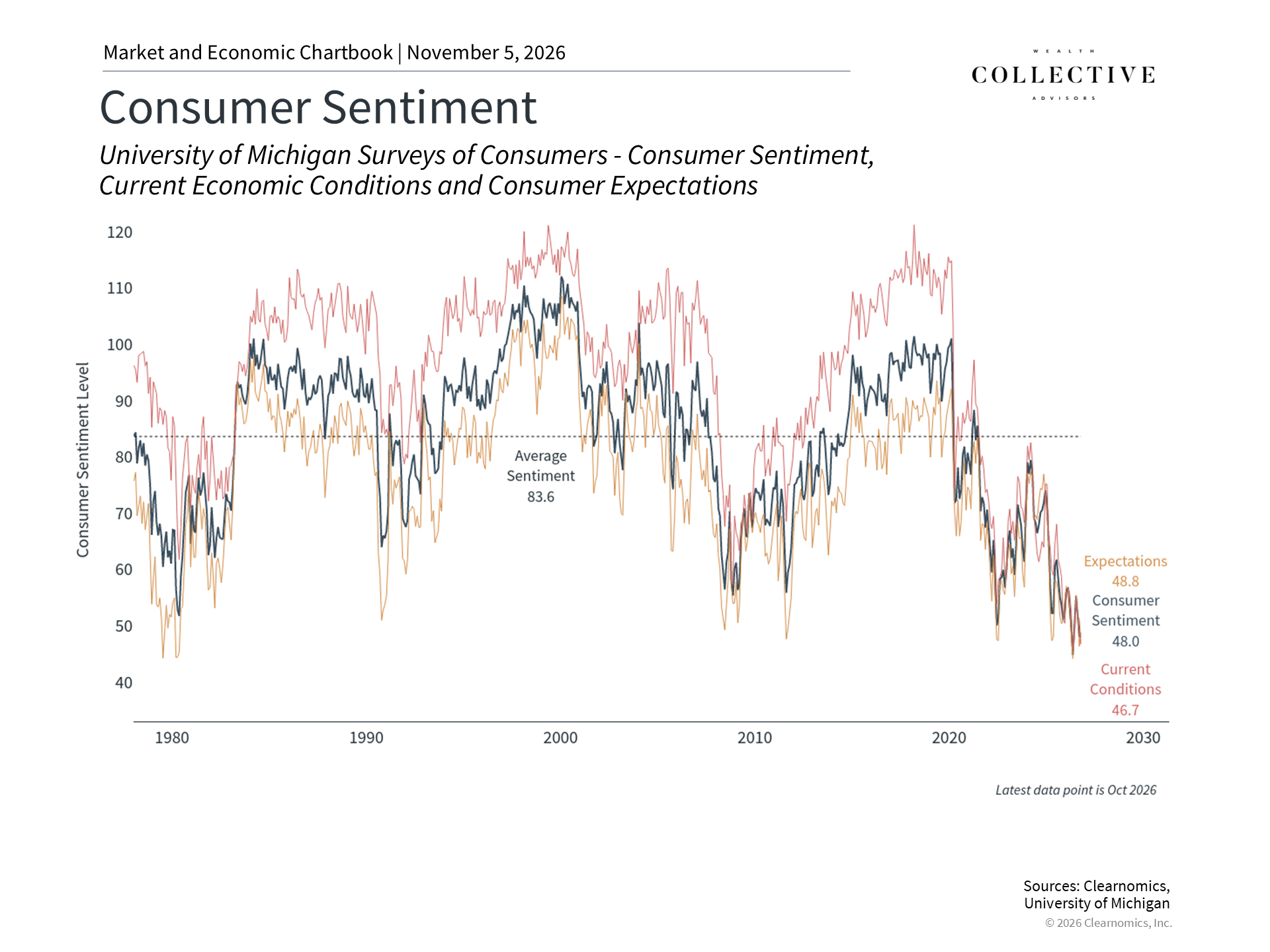
Consumer sentiment, which measures how people feel about current and future economic conditions, has fallen sharply in recent years. October’s reading of the University of Michigan index was the second lowest on record going back to 1952.1 Rising prices, a national average gasoline price of $4.12 per gallon, a 30-year mortgage rate around 7.3%, and Consumer Price Index (CPI) inflation of 3.7% in September have all weighed on households.
Interestingly, overall consumer spending has held up well. The latest Gross Domestic Product (GDP) report for the third quarter shows that consumer spending grew 2.5% at a seasonally adjusted annual rate, helping overall economic growth to exceed expectations.2 How consumers feel and how they actually spend do not always move together, and the same gap can exist between sentiment and portfolio performance.
Policy uncertainty has created short-term market swings
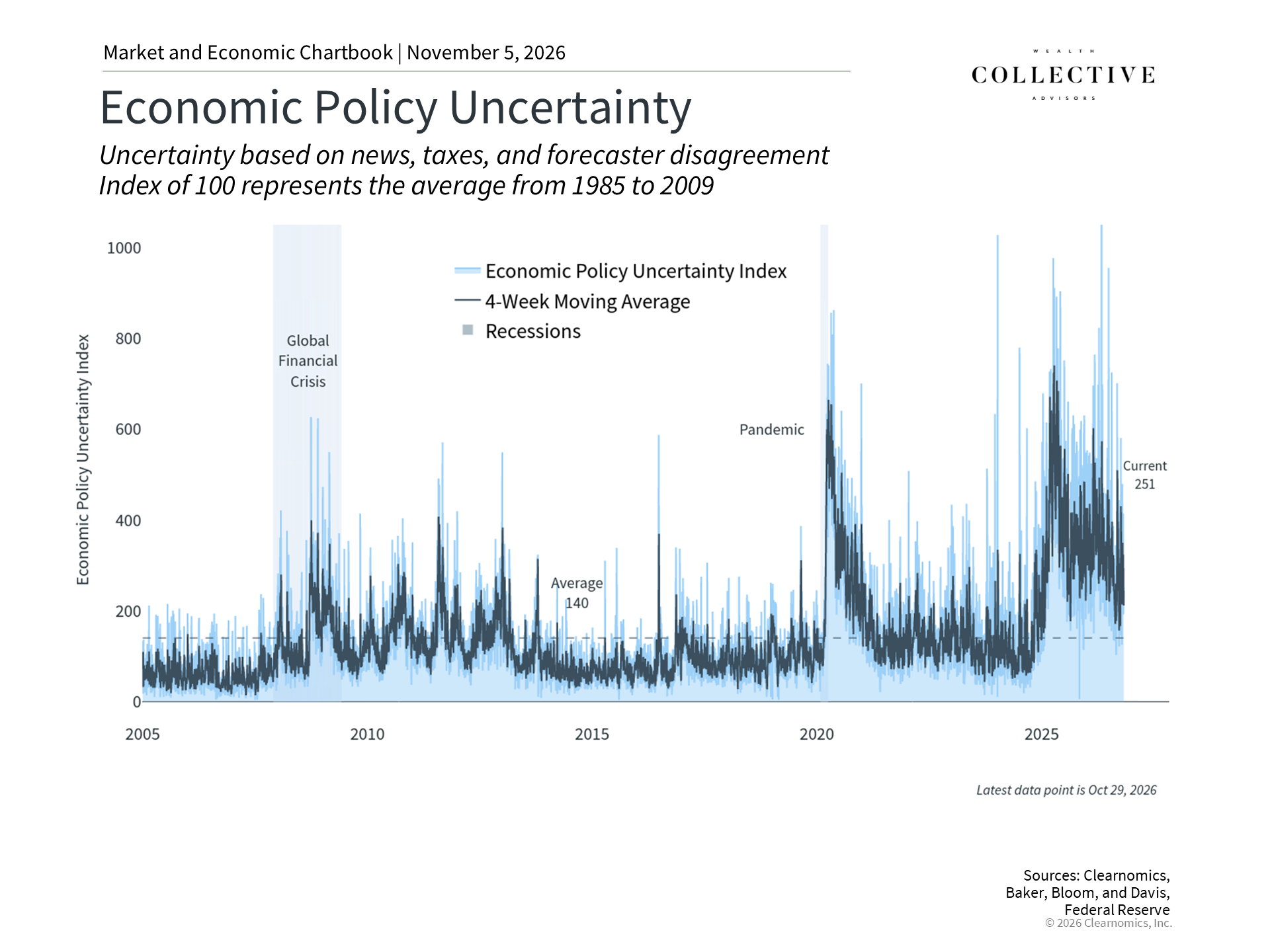
Uncertainty around policy has contributed to short-term market volatility in recent years. Tariffs, the One Big Beautiful Bill Act, the rising national debt, and the war in Iran have all created periods of instability. As the chart above shows, uncertainty spiked around last year’s “Liberation Day” announcements, the debate over tax policy, and this year’s Middle East conflict. In each case, markets experienced turbulence before settling down as investors refocused on economic fundamentals.
A divided government often means fewer sweeping policy changes, since major legislation requires agreement across both parties. This can reduce sudden shifts for businesses and markets, even if it slows the pace of new initiatives. One area many will watch closely is the federal budget and the debt ceiling, where upcoming deadlines will require consensus to avoid a government shutdown.
Another area of interest is data centers, which support AI technology and have been a meaningful driver of economic growth and corporate profits. Early results from at least 41 local ballot measures on data center construction show that voters in most areas favored new restrictions, with 37 jurisdictions choosing to limit development. One measure in Kansas banned “high-impact data centers,” defined as facilities using more than ten megawatts of electricity or 100,000 gallons of water per day, for 10 years.3
The economy has grown under both political parties
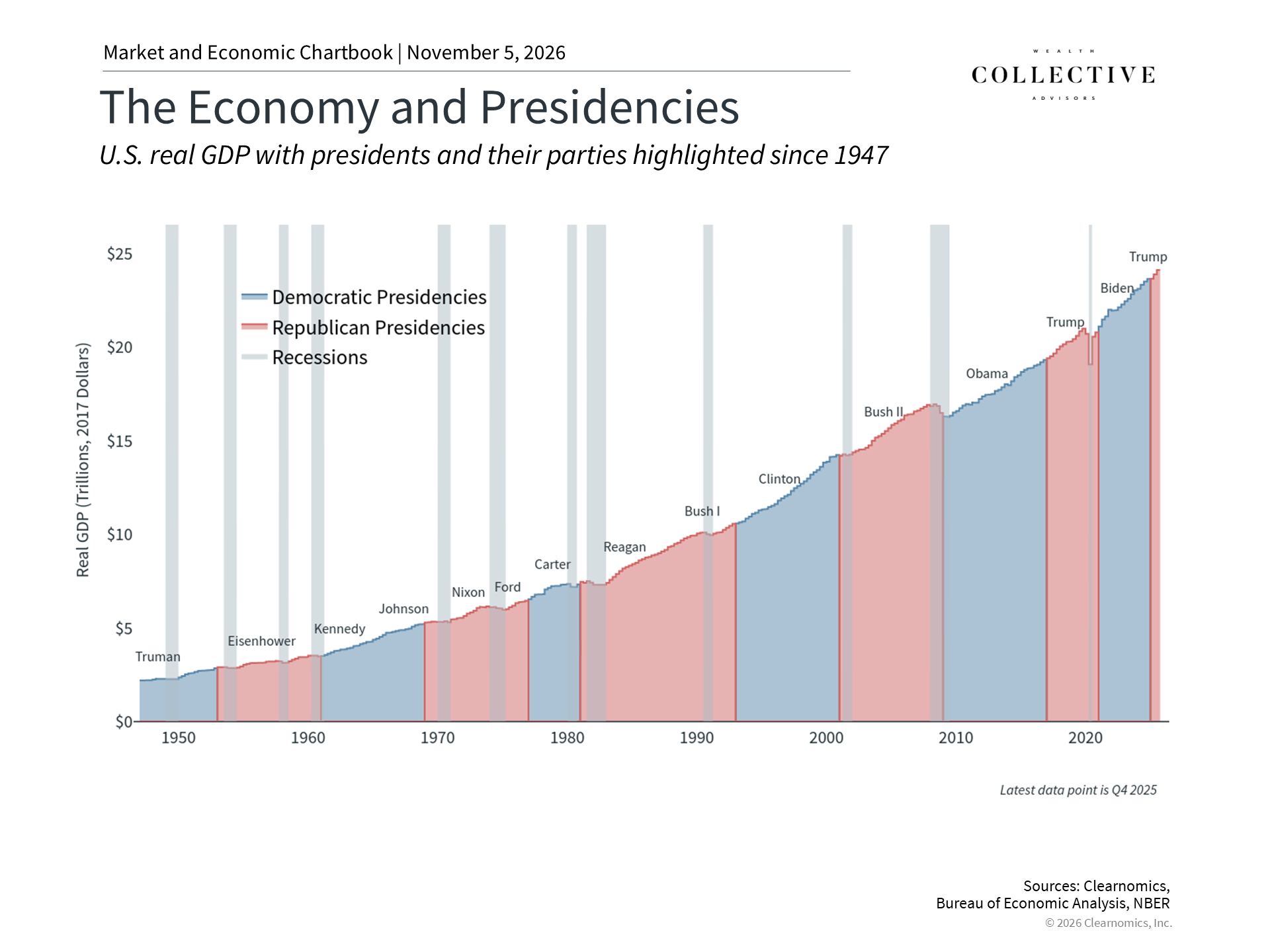
The most important reminder for long-term investors is that the economy has grown across many different political environments. The chart above shows U.S. real GDP (GDP adjusted for inflation) under each president going back to 1947, including many periods of divided government. In each case, long-run economic growth was shaped more by business cycles and broader trends than by which party held power.
This does not mean that policy is unimportant. Changes in areas like taxes, geopolitics, and entitlement programs can have real effects. However, history shows that these issues are rarely the primary drivers of long-term investment outcomes. It is worth separating political views from financial decisions and avoiding the temptation to make major portfolio changes based on election results.
The bottom line? The midterm election results reflect voters’ concerns about the economy and rising prices, but sentiment and political outcomes do not always translate directly to portfolio performance. Investors should continue to stay balanced and focused on long-term trends throughout political cycles.
References
- https://www.sca.isr.umich.edu/
- https://www.bea.gov/data/gdp/gross-domestic-product
- https://ballotpedia.org/El_Dorado,_Kansas,_Prohibit_Data_Centers_and_Battery_Energy_Storage_Systems_Initiative_(November_2026)