When you claim Social Security can have a lasting impact on your retirement income. But choosing the right age involves more than simply calculating which option produces the largest monthly check.
You can begin collecting Social Security as early as age 62, but doing so means accepting a permanently reduced monthly benefit. Waiting until your full retirement age (67 for anyone born in 1960 or later) allows you to receive your full benefit. And delaying until age 70 can increase that benefit even further.
For retirees with meaningful investment assets, the decision often comes down to balancing income today with greater financial security later. There isn’t one right answer for everyone. Your health, family circumstances, taxes, investment portfolio, and retirement goals all play a role.
Understanding Your Three Main Options
The age you begin collecting Social Security determines your starting monthly benefit. Here’s how the three most common claiming ages compare.
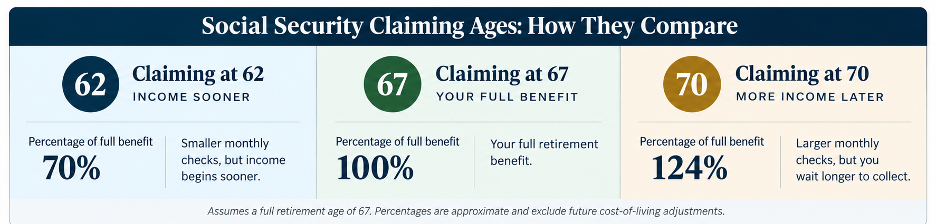
Claiming at 62: Income sooner
Collecting benefits early can make sense if you’re retiring before 67, need additional cash flow, or have health concerns that may affect your life expectancy.
The trade-off is a smaller monthly payment for the rest of your life. If you’re still working, your benefits may also be temporarily withheld if your earnings exceed Social Security’s annual limits.
Claiming at 67: A middle ground
For those born in 1960 or later, age 67 is when you qualify for your full retirement benefit. Claiming at this age avoids the reduction associated with early filing while allowing you to begin receiving income three years sooner than waiting until 70.
Claiming at 70: More income later
If you have other resources to support your retirement spending, waiting until age 70 may be particularly attractive.
For someone whose full retirement age is 67, delaying until 70 increases the monthly benefit by 24% compared with claiming at 67. That larger benefit also receives future cost-of-living adjustments, providing an important source of inflation-adjusted income later in life.
This can be especially valuable if you live into your 80s or 90s, or if a surviving spouse may eventually depend on your benefit.
Why Waiting Can Make Sense for Savers
One advantage of having a well-funded retirement portfolio is flexibility. You may not need Social Security immediately to cover your living expenses.
Delaying Social Security can increase the amount of lifetime income supported by the federal government, reduce reliance on investments later in retirement, and provide additional protection against the financial risk of living longer than expected.
Think of it as one way to help protect the later years of retirement, when market fluctuations, health care costs, and longevity can become increasingly important.
Of course, waiting isn’t always the best choice. Drawing from investments earlier also has costs, including the potential loss of future investment growth. That’s why the decision should be evaluated alongside your broader financial plan.
Married Couples Have Another Important Consideration
For married couples, Social Security decisions should generally be made together rather than independently. One of the most important considerations is the potential survivor benefit.
When one spouse passes away, the surviving spouse generally receives the higher of the two applicable benefits, not both. This means the higher-earning spouse’s decision to delay Social Security can have a meaningful impact on the surviving spouse’s financial security.
For example, delaying the higher earner’s benefit until age 70 may provide a larger income stream that continues throughout the surviving spouse’s lifetime, subject to the applicable survivor-benefit rules.
Age differences, health, earnings histories, and other retirement income sources all influence the decision. Sometimes it makes sense for one spouse to claim earlier while the other waits.
The goal isn’t necessarily to maximize each person’s benefit. It’s to create the best outcome for the household.
Don’t Overlook the Tax Implications
Many retirees are surprised to learn that Social Security benefits aren’t always tax-free. Depending on your income, up to 85% of your Social Security benefits may be included in federal taxable income.
For retirees with traditional IRAs, 401(k)s, taxable investments, or other income sources, the timing of Social Security can affect the bigger tax picture.
Consider a retiree who delays Social Security until age 70. The years between retirement and claiming benefits may provide an opportunity to make strategic Roth conversions, withdraw from tax-deferred accounts at favorable tax rates, or realize investment gains while taxable income is relatively low.
These strategies can potentially reduce future required minimum distributions and improve lifetime tax efficiency.
The objective isn’t simply to pay the least amount of tax this year. It’s to manage how much of your wealth goes toward taxes throughout retirement.
What About Medicare Premiums?
Another factor worth considering is Medicare’s income-related monthly adjustment amount, commonly called IRMAA.
Higher-income retirees may pay additional premiums for Medicare Part B and Part D. These surcharges are generally determined using income reported on tax returns from two years earlier.
Large IRA withdrawals, Roth conversions, and realized investment gains can all increase the income used to calculate Medicare premiums.
For affluent retirees, avoiding every Medicare surcharge isn’t necessarily the goal. Sometimes paying a higher premium for a year or two may be worthwhile if it supports a larger long-term tax-saving strategy.
The important thing is understanding these potential costs before making decisions.
If your income falls because of retirement or another qualifying life-changing event, you may also be eligible to request a reduction in your Medicare income-related premiums.
Should You Spend Your Investments Before Collecting Social Security?
Traditionally, retirees may feel more comfortable collecting Social Security as soon as possible to avoid withdrawing money from their investments.
However, using a portion of your portfolio during the early retirement years may allow you to delay Social Security and establish a larger inflation-adjusted income stream later.
That larger benefit can help cover essential spending, reduce the amount you need to withdraw from investments in later years, and provide additional financial security if you live longer than expected.
On the other hand, taking Social Security earlier may allow more of your investments to remain invested and potentially grow.
Neither strategy is universally better. The answer depends on expected investment returns, taxes, longevity, market risk, and how much flexibility your financial plan provides.
How Long Do You Need to Live for Delaying to Pay Off?
One useful way to compare claiming strategies is to calculate the break-even age—the point when the total benefits received from waiting exceed what you would have collected by claiming earlier.
Let’s assume your full Social Security benefit at age 67 is $3,000 per month.
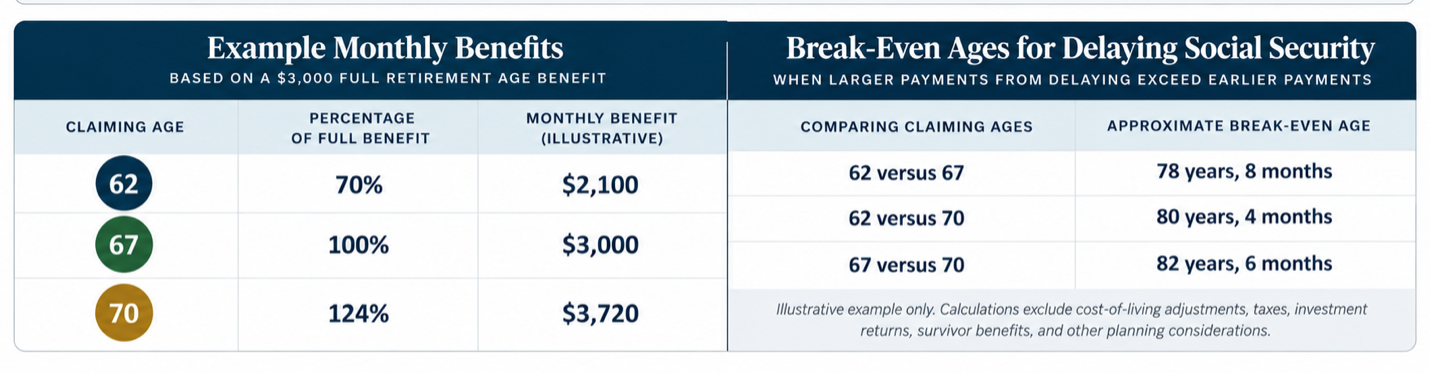
These numbers provide a helpful starting point, but they don’t tell the entire story.
For example, if you collect benefits early and invest the payments, your investment returns could change the calculation. Likewise, if delaying Social Security requires larger portfolio withdrawals during a market downturn, that could affect your retirement plan.
And for married couples, the financial value of a larger survivor benefit may extend well beyond the original claimant’s lifetime.
The break-even age is useful, but it shouldn’t be the only factor driving your decision.
Frequently Asked Questions
Should everyone wait until age 70 to claim Social Security?
No. While delaying can provide a larger monthly benefit, claiming earlier may make sense based on your health, income needs, or overall financial circumstances. The best choice depends on your individual retirement plan.
Should spouses claim Social Security at the same time?
Not necessarily. In many cases, coordinating claiming ages can produce a better long-term outcome, particularly when one spouse has a significantly higher benefit or when survivor benefits are an important consideration.
Can I work while collecting Social Security?
Yes. However, if you claim before full retirement age, Social Security may temporarily withhold some benefits when your employment earnings exceed certain limits. Once you reach full retirement age, those earnings limits no longer apply, and benefits are recalculated to account for months when payments were withheld.
Did the government eliminate taxes on Social Security?
No. Although a temporary enhanced federal tax deduction is available to certain individuals age 65 and older for tax years 2025 through 2028, Social Security benefits can still be taxable under existing federal rules. The deduction has income limits and other eligibility requirements.
Do I still need to enroll in Medicare at age 65 if I delay Social Security?
Generally, yes, unless you qualify to delay enrollment without penalty, such as through certain employer-sponsored health coverage. Social Security and Medicare have separate enrollment considerations.
The Bottom Line: The best age to claim Social Security isn’t necessarily the earliest age you can collect or the latest age that maximizes your monthly benefit. It’s the age that best supports your overall retirement plan.
Advisory services are offered through Collective Wealth Advisors LLC, a Registered Investment Adviser with the SEC. For informational and educational purposes only and should not be construed as specific investment, accounting, legal, or tax advice. Certain information is based upon third party data which may become outdated or otherwise superseded without notice. Third party information is deemed to be reliable, but its accuracy and completeness cannot be guaranteed. Neither the Securities and Exchange Commission (SEC) nor any other federal or state agency have ap- proved, determined the accuracy, or confirmed the adequacy of this article.