Artificial intelligence has quickly become one of the most powerful forces shaping markets—and one of the most common questions investors are asking is: Are we in an AI bubble?
A market “bubble” generally describes a period when investment prices rise rapidly, potentially beyond what fundamentals can justify, before eventually falling sharply. The challenge is that bubbles are much easier to identify after they burst. In 1996, technology stocks already looked expensive, yet investors who exited missed several more years of substantial gains. By 1999, valuations looked expensive again—and this time the concern proved justified.
Rather than trying to predict whether AI is a bubble, we believe investors should focus on three more useful questions:
- What do I actually own?
- How is the AI buildout being financed?
- And is my portfolio prepared for different outcomes?
What Do You Actually Own?
One of the most significant developments in the U.S. stock market has been the growing concentration of the S&P 500. As of August 10, 2026, the ten largest companies represented approximately 38% of the index. For much of the period between 1990 and 2015, that figure generally ranged between 18% and 23%.
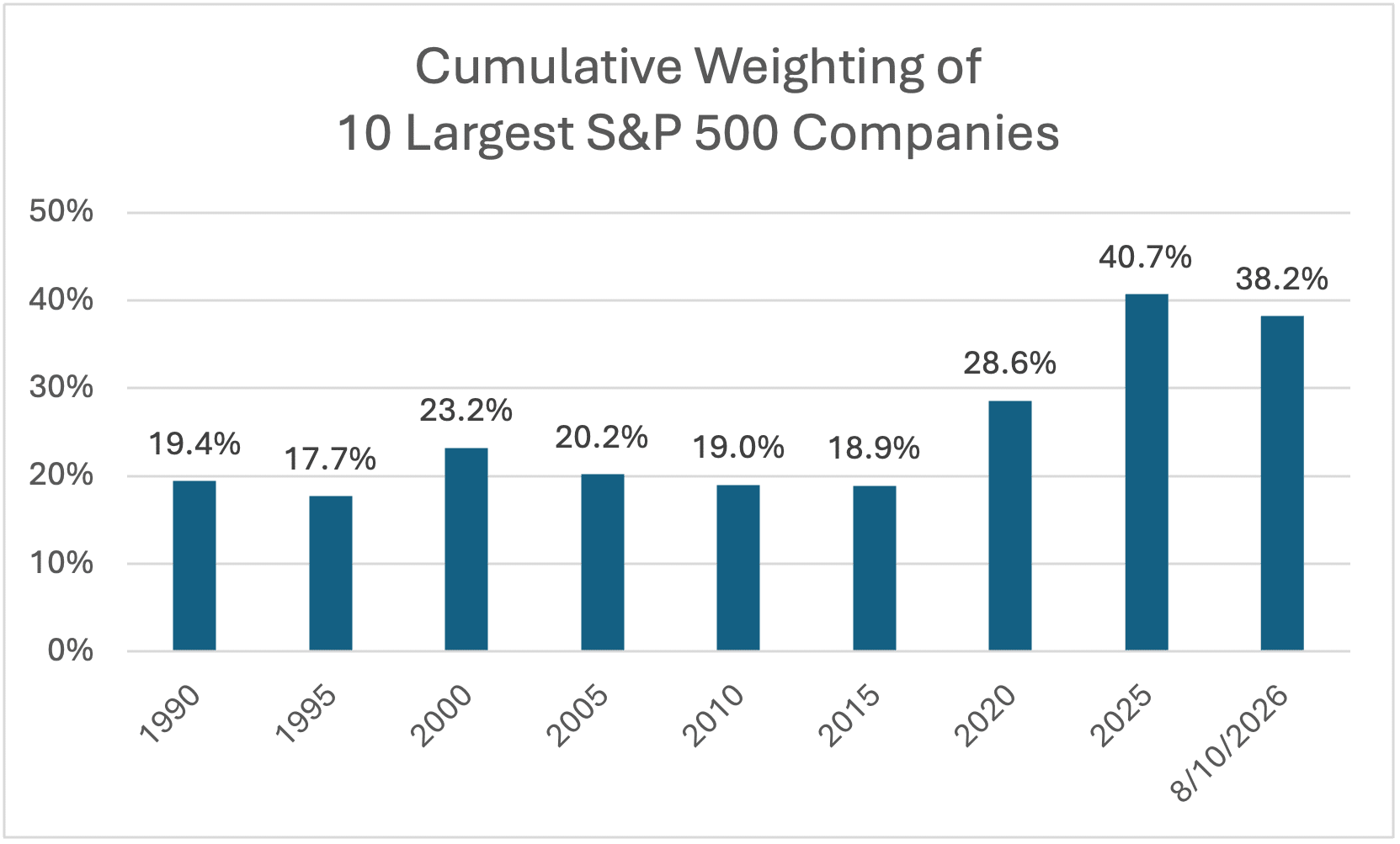
Source: RBC Wealth Management, FactSet; data reflects year-end weighting for each year
This is not an argument against index investing. It is simply important to understand that someone who has owned the same S&P 500 index fund for the past decade owns a considerably more concentrated portfolio today, with a greater portion of performance dependent on a relatively small number of very large companies—many tied closely to AI and technology.
Concentration doesn’t tell us what markets will do next. It tells us where more of the risk and opportunity now reside.
How Is the AI Buildout Being Paid For?
There is an important difference between today’s AI leaders and many companies associated with the late-1990s technology boom. Today’s largest technology companies are highly profitable businesses with enormous customer bases, substantial cash flows and strong balance sheets.
At the same time, the amount of capital being committed to AI infrastructure is extraordinary. Capital expenditures among five of the largest cloud and AI infrastructure companies are expected to exceed $690 billion in 2026, with estimates for 2027 approaching $870 billion. PIMCO estimates this spending could consume approximately 94% of these companies’ operating cash flows during 2026 and 2027, compared with roughly 40% in 2023.[1]
As spending grows, companies are increasingly using debt and long-term lease commitments in addition to their own cash flow. This doesn’t mean financial trouble is inevitable. These remain exceptionally strong companies, and borrowing to invest in future growth is normal corporate finance. But it raises an important long-term question: Will the economic return from AI ultimately justify the enormous amount of capital being invested today?
Transformative Technology Doesn’t Always Equal Great Investment Returns
AI can transform the economy and still produce disappointing returns for some investors. Those ideas are not contradictory.
History provides plenty of examples. Railroads transformed commerce, and the internet transformed communication and business. Both created enormous economic value, yet investors who financed certain companies or paid too much for anticipated growth still experienced significant losses.
The important questions aren’t simply whether AI will succeed, but which companies will ultimately capture the value it creates and how much investors are paying today for that future success. Those are extraordinarily difficult questions to answer in advance.
What Does This Mean for Your Portfolio?
At CWA, we do not believe a single market observation—even an important one—should dictate major portfolio changes. U.S. stock valuations are elevated relative to many historical measures, but valuations have historically been much better at informing long-term return expectations than predicting what markets will do over the next year or two.
The same applies to concentration. What today’s concentration tells us is that more of the market’s outcome depends on fewer companies, which reinforces the importance of diversification.
If AI fulfills the enormous expectations being placed upon it, diversified investors can participate in that growth. If AI-related investments disappoint, diversification across company sizes, investment styles, industries, geographies and asset classes can help reduce dependence on any single outcome. Diversifying beyond today’s largest technology companies is not a bet against AI; it is recognition that we cannot know in advance which companies will ultimately capture the greatest value from it.
This principle increasingly applies to fixed income as well. As AI infrastructure spending expands into corporate debt markets, diversification across issuers, sectors and maturities remains an important part of managing portfolio risk.
Planning, Not Predicting
We do not know whether today’s AI enthusiasm will eventually be remembered as a bubble, and successful investing does not require us to know.
At CWA, our approach isn’t built around predicting the next market winner, recession, technology breakthrough or bubble. It is built around constructing portfolios that can participate in long-term economic growth while remaining diversified enough that a client’s financial future does not depend on getting any single prediction right.
The more useful question isn’t, “Is AI a bubble?” It is, “Is my financial plan and portfolio prepared if it is—and prepared if it isn’t?”
That is a question we can plan for.
Sources
[1] PIMCO, AI Credit Expansion: Assessing the Micro and Macro Risks.
[2] FactSet, Hyperscalers Tap External Financing as AI Capex Outruns Cash Flow.
[3] Breckinridge Capital Advisors, The Price of AI: How Capex Is Rewriting Tech Balance Sheets.
[4] Moody’s Ratings data reported by CNBC, July 24, 2026.
Advisory services are offered through Collective Wealth Advisors LLC, a Registered Investment Adviser with the SEC. For informational and educational purposes only and should not be construed as specific investment, accounting, legal, or tax advice. Certain information is based upon third party data which may become outdated or otherwise superseded without notice. Third party information is deemed to be reliable, but its accuracy and completeness cannot be guaranteed. Neither the Securities and Exchange Commission (SEC) nor any other federal or state agency have ap- proved, determined the accuracy, or confirmed the adequacy of this article.