With the November midterm election drawing closer, political campaigns are intensifying across the country. Politics have grown increasingly divisive over recent decades, making it natural for investors to wonder whether election outcomes should influence their financial decisions. Now more than ever, it is essential to keep political views separate from investment decisions and avoid letting those views drive changes to financial plans.1
Midterm elections take place every four years, at the midpoint between presidential election cycles, and help determine the makeup of Congress. Current polling suggests that a divided government is the most likely outcome, though margins remain thin in both chambers, meaning much could change over the coming months.2 In the House, a majority requires 218 seats, and Republicans currently hold 219, meaning Democrats could secure control by flipping just a handful of races. In the Senate, Republicans hold a firmer advantage with 53 seats, though expectations in prediction markets have been shifting in recent months.3
As citizens, voters, and taxpayers, elections carry enormous significance. They shape the direction of policy on issues ranging from entitlement programs and taxes to the federal debt. That said, investors need not get caught up in the details of each race. History demonstrates that Washington politics matter far less to long-term portfolio outcomes than many might expect. Understanding why this is the case can help investors remain focused on their long-term goals as the election season intensifies.
Midterm election years have historically delivered positive average returns
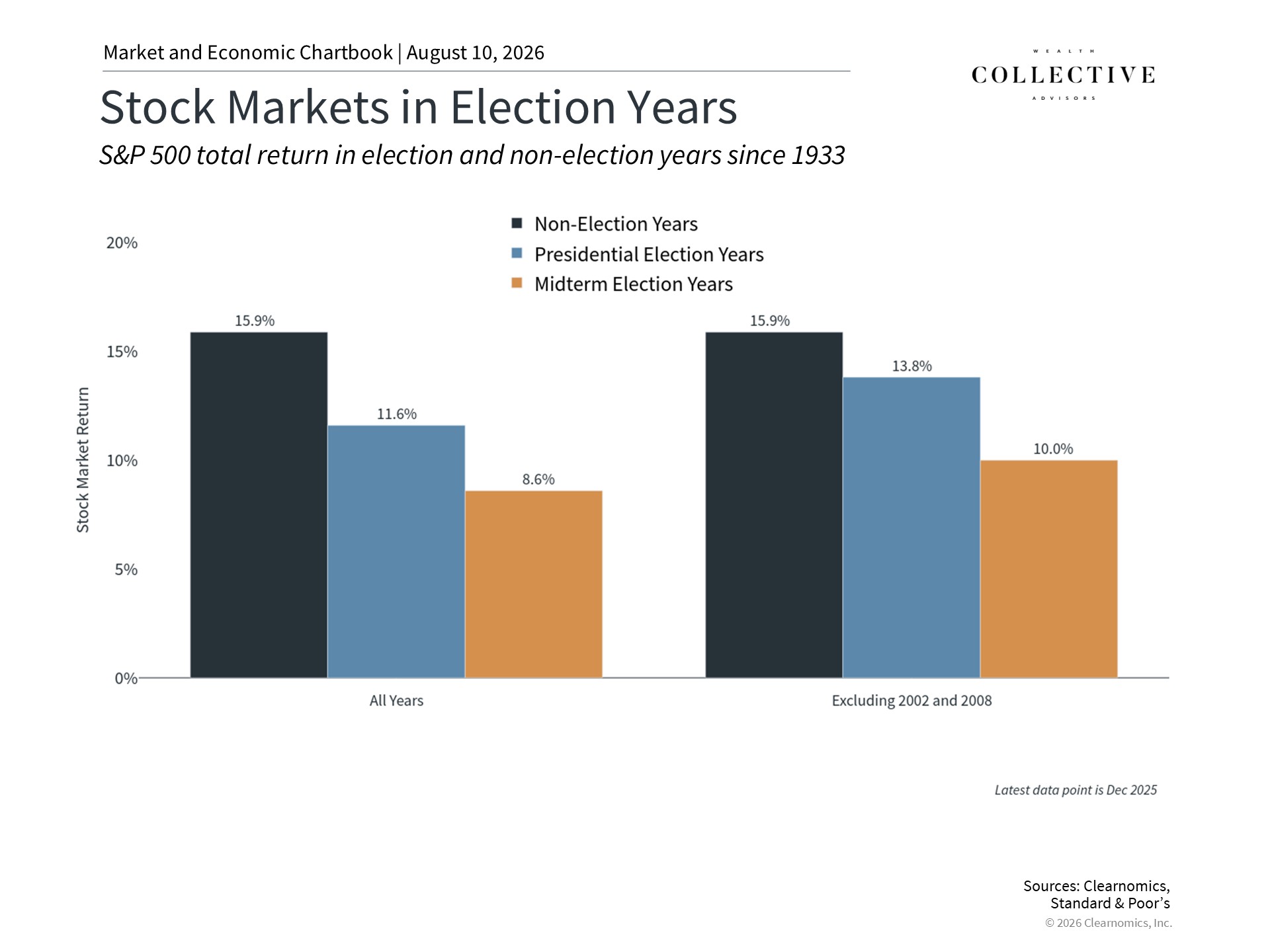
It may seem intuitive that politics should have a meaningful impact on stock market performance, and that election years might be best avoided by cautious investors. Since elections influence economic policy, which in turn affects industries and companies, it is easy to assume that such years would simply be more volatile.
History, however, tells a different story. The accompanying chart shows that returns have been positive on average across different types of election and non-election years, going back to the era of the Great Depression. While natural variation exists between the averages of these year types, markets have performed well under Republican, Democratic, and divided governments alike.4
This is not to suggest that all years produce positive outcomes. Each period is shaped by a unique set of circumstances tied to the phase of the business cycle. Recent midterm election years offer a useful illustration: 2022 saw significant inflation in the aftermath of the pandemic, while 2018 was marked by concerns over global growth and Federal Reserve policy. In both instances, negative returns reflected underlying economic trends rather than the fact that a midterm election was occurring.
Longer-term market trends are similarly disconnected from politics. The information technology revolution that began in the 1990s, the housing boom and bust of the mid-2000s, the inflationary impact of the pandemic after 2020, and the current wave of AI innovation all shaped markets in significant ways that had little to do with which party controlled the White House or Congress.
It is also common for a president who begins a term with a Congressional majority to lose it during the midterms. In recent decades, this occurred for President Biden during his single term, President Obama in his first term, President George W. Bush in his second term, and President Clinton in his first term, among others. Political scientists have studied many reasons for this pattern, including shifting voter preferences and psychology at the two-year mark of a four-year presidential term. Regardless of the causes, both markets and the broader economy have grown steadily across these decades.
The economy and interest rates are more influential than election outcomes
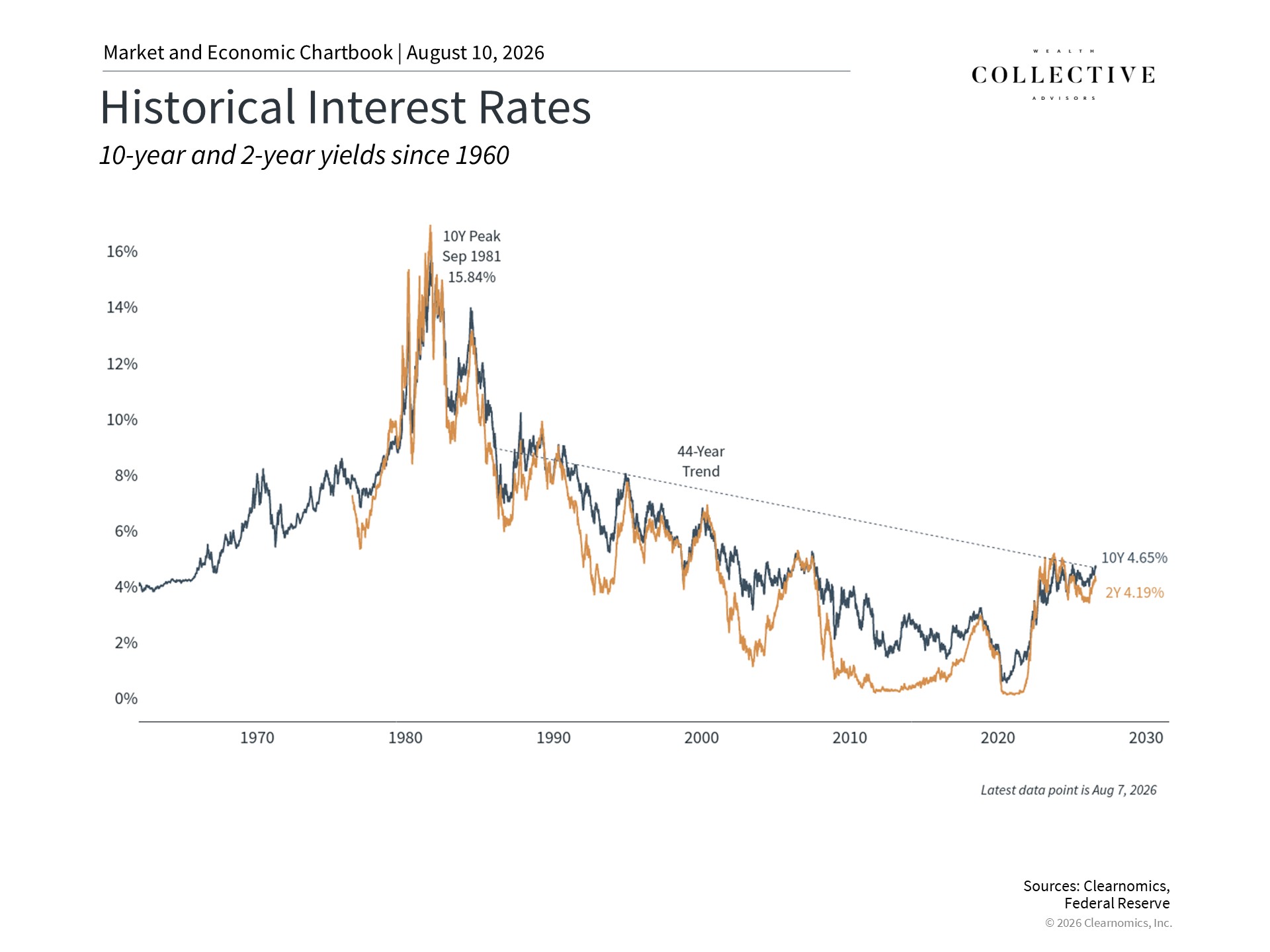
For long-term investors, the business cycle and interest rates have historically been far more consequential drivers of markets and portfolios than the composition of the White House or Congress. The chart above illustrates the current period of elevated rates and their effects on markets, businesses, and consumers. While policymakers can influence interest rates to some degree, they are ultimately shaped by longer-term structural trends.
This distinction matters because political change tends to occur gradually and with a lag. The difficulty of sustaining Congressional majorities reflects the deliberate design of the political system. Even when policy shifts appear significant, such as changes to taxes and tariffs in recent years, their actual effects on markets, whether positive or negative, are often less immediate and less dramatic than anticipated. This is because economic growth, corporate earnings, inflation, and employment are influenced by a wide range of factors beyond politics.
This year’s election is unfolding against a backdrop of geopolitical conflict, inflation, AI-related developments, and more. These factors have been far larger drivers of markets, corporate earnings, and interest rates than the specifics of individual Congressional contests. Major stock market indices have still generated double-digit returns despite brief periods of uncertainty. While the midterm election is a notable event, it remains important to stay focused on the broader economic environment.
Market growth has continued across administrations of both parties
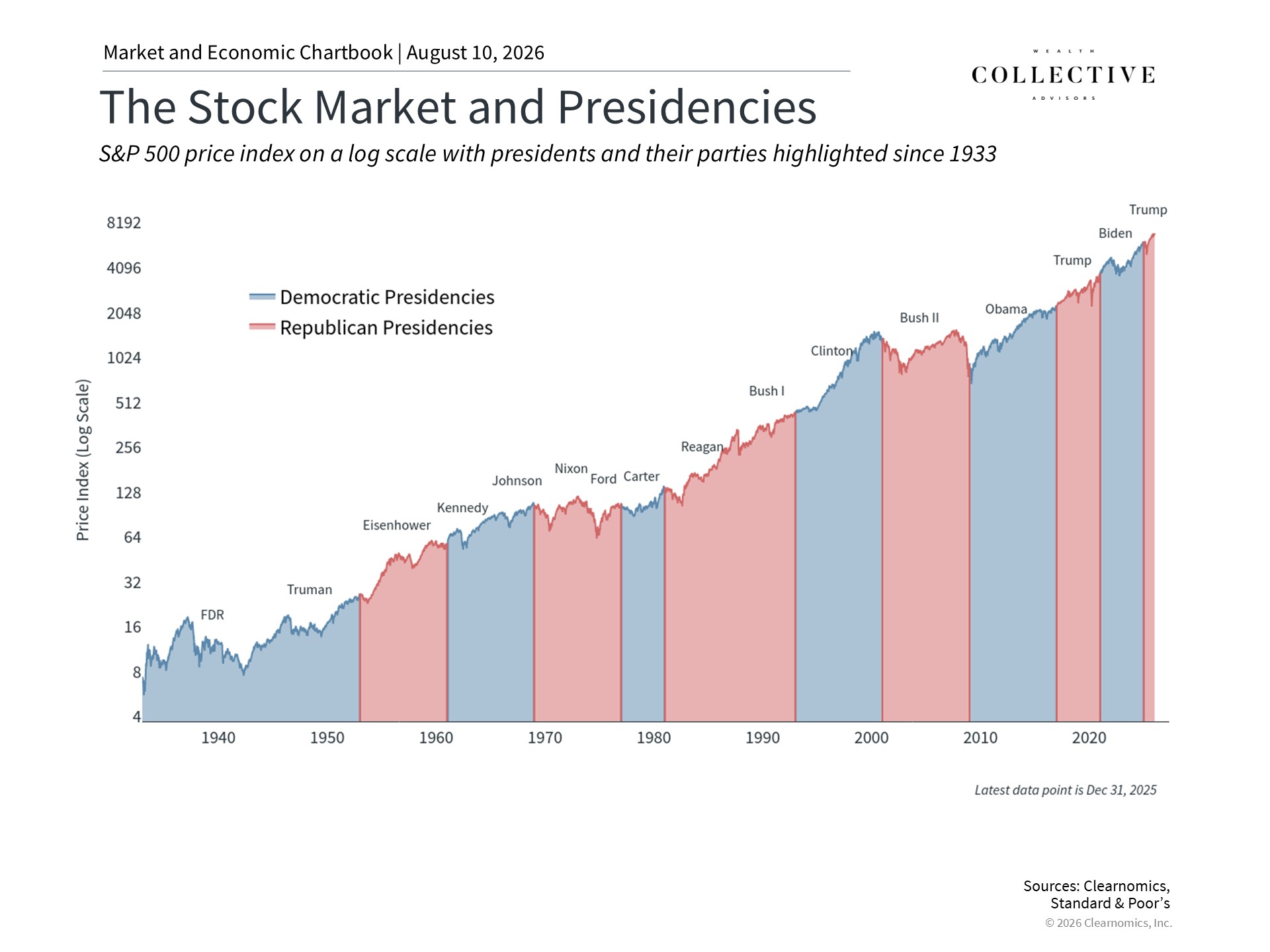
Perhaps the most valuable perspective for long-term investors is that markets have performed well across many different political cycles. The accompanying chart shows that the S&P 500 has grown over the past century, spanning diverse political environments, wars, recessions, policy shifts, and much more in between.5
This is not to suggest that policy is unimportant or that markets are immune to volatility. Debates around tax rates, defense spending, and the federal debt can have real consequences for the economy over time. The outcome of this election could influence the legislative agenda, including the trajectory of the Iran conflict, tax provisions, tariffs, and the national debt. These are matters that many investors follow closely.
The key, however, is to distinguish between what investors can and cannot control when it comes to portfolios and financial plans. It is important for voters to make their voices heard through the ballot box, not through their hard-earned savings. Holding a portfolio designed to perform across a range of economic and political environments is a more sound approach than attempting to predict the result of any single election.
The bottom line? Midterm elections carry great importance for the country, but it is essential to keep politics separate from investing. History shows that, even in election years, maintaining discipline and focusing on fundamentals is the most reliable path to achieving long-term financial goals.
References
- https://www.usa.gov/midterm-elections
- https://www.realclearpolling.com/latest-polls/2026
- https://polymarket.com/event/balance-of-power-2026-midterms
- Clearnomicsresearch and Standard & Poor’s data, as of August 7, 2026
- Clearnomicsresearch and Standard & Poor’s data, as of August 7, 2026
Index Descriptions
S&P 500
The Standard & Poor’s 500 Index is a capitalization-weighted index of 500 stocks designed to measure performance of the broad domestic economy through changes in the aggregate market value of 500 stocks representing all major industries. The modern design of the S&P 500 stock index was first launched in 1957. Performance prior to 1957 incorporates the performance of the predecessor index, the S&P 90.
Advisory services are offered through Collective Wealth Advisors LLC, a Registered Investment Adviser with the SEC. For informational and educational purposes only and should not be construed as specific investment, accounting, legal, or tax advice. Certain information is based upon third party data which may become outdated or otherwise superseded without notice. Third party information is deemed to be reliable, but its accuracy and completeness cannot be guaranteed. Neither the Securities and Exchange Commission (SEC) nor any other federal or state agency have ap- proved, determined the accuracy, or confirmed the adequacy of this article.